
One hypothesis about COVID-19 is that the more virus someone is exposed to, the sicker they may become. This is being referred to as ‘viral load’. For instance, one of the first high-profile casualties of COVID-19 was Dr. Li Wenliang. Despite his youth and good health, and every possible intervention being taken on his behalf, he died of the disease. People speculated that this was because, as a caregiver, he was exposed to high viral load.
COVID-19 isn’t the only infectious pathogen where exposure dose matters. Parents of young children reading this probably have first-hand knowledge of this (I do). It’s one thing to be exposed to a cold at work when a colleague sneezes on you in a crowded elevator and a couple of viral particles ride the airstream up into your nostrils. It’s quite another when your small child, who is a Petri dish full of daycare germs, is sick and upset and clingy and smears and spreads and sprays their body fluids all over you and your orifices in the middle of the night. In the first few years of your child’s life, you repeatedly get sicker than you’ve ever been and your childless colleagues start asking if you’ve maybe got an undiagnosed immune deficiency. Nah, they’re just witnessing the influence of a very high inoculation dose to a lot of diseases you’re not currently immune to.
Non-anecdotally, in many diseases, from water-borne pathogens like cholera and giardia to RNA viruses like norovirus and influenza A, the infectious dose matters, so it’s a reasonable hypothesis that viral load exposure matters in fellow RNA virus COVID-19 too.
What does seem to be quite unique about COVID-19, however, is that people can shed a lot of virus before they experience any symptoms at all. In other words, people who seem perfectly healthy can make you very very sick.
However, I don’t want this post to be all doom and gloom– instead, I’m hoping to reframe some of the actions we’re already taking to avoid the virus in terms of reducing infectious dose. Trying to avoid any possible viral exposure (at all, ever!) can seem impossible and can lead to feelings of anxiety, hopelessness, and powerlessness. When I learned to work with radioactivity in the laboratory, we were taught a principle known as ALARA: As Low As Reasonably Achievable. Can we apply this principle to COVID-19?
Here are some ideas, most of which, I hope, are common sense:
- Full and adequate PPE for all of our frontline workers. Enough said.
- Let’s all get used to wearing masks. Even homemade masks provide some level of protection, and can decrease viral exposure.
- Keep your distance from other people when out in public. The further you can stay from other people (even if you’re both wearing masks), the safer we’ll all be.
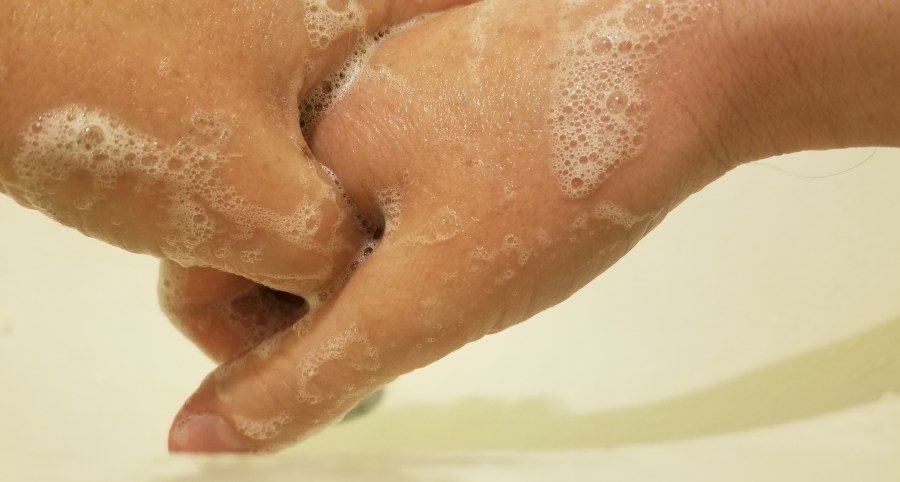
- Wash your hands frequently. Hand sanitizer is OK when you’re unable to get to a sink, but soap and water do a great job when you’re at home.
- Don’t eat with your hands. Use utensils that have been thoroughly cleaned in a dishwasher or with dish soap and hot water.
- Clean your home regularly.
- If you are caring for or living with someone who is sick (even if you don’t know if it’s COVID-19), you both should be wearing a mask as much as possible even within your home. Sanitize, clean, and isolate yourself from your patient to the extent that is emotionally and physically possible. Wear gloves if possible to clean—they don’t have to be disposable gloves, dishwashing gloves work very well and can be chemically disinfected and reused indefinitely. Again, you may not be able to totally eliminate your risk of exposure but if you can reduce the viral load you’re exposed to, this may turn out to be very important.
- Clean the toilets in your home, and keep the lids down to ensure your pets don’t drink from them! COVID-19 is shed in stool, and you also don’t want your pets exposed to cleaning products.
- If you have to change diapers, or wipe your kid’s butt (sorry, non-parents, fact of life for many of us), wear disposable gloves whenever possible. Use extra care when disposing of or cleaning soiled diapers. Of course, also wash your hands afterwards.
- If you are feeling even slightly ill, do not prepare food for your family. Do not allow anyone who is ill to prepare food for you.
- Keep wipes and hand sanitizer in your car and use frequently.
- Leave your shoes at the door.
- When cleaning, focus on the ‘high touch surfaces’ of your home and car: light switches, door knobs, faucet handles, steering wheel, car door handles, cell phone, computer keyboards, etc.
- Shower daily (Hey, I know you might not have to go into work but cleanliness is important. And even if this doesn’t help avoid COVID-19, your partner who is under lockdown with you will likely appreciate it).
Keep up the good fight.
Stay healthy.

 The Megascope